Showing posts with label Yirra Yaakin. Show all posts

Monday, February 14, 2022

Musical: Panawathi Girl

by David Milroy
Yirra Yaakin Theatre Company
for the Perth Festival
Director Eva Grace Mullaley
Musical Director Wayne Freer
Choreographer Janine Oxenham
Set designer Bruce McKinven
Lighting designer Lucy Birkenshaw
Sound designer Jeremy Turner
Performed by Grace Chow, Peter Docker, Luke Hewitt, Chris Isaacs, Geoff Kelso, Angelica Lockyer, Nadia Martich, Lila McGuire, Gus Noakes, Teresa Rose, Maitland Schnaars, Manuao TeAotonga and  Wimiya Woodley
His Majesty’s Theatre
February 10 – 13, 2022
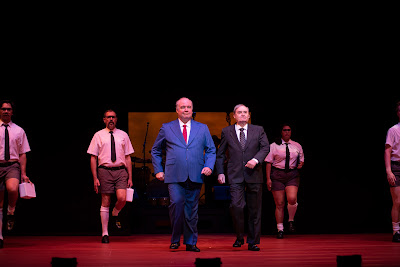
Luke Hewitt and Geoff Kelso and the Long White Socks  (pic Dana Weeks)

It’s easy to see why much excitement accompanied the world premiere of David Milroy’s Panawathi Girl, and it’s pleasing to report that it’s a catchy, warm-hearted show that understands the simple virtues of the Broadway musical while maintaining a distinctly Australian – and specifically West Australian – flavour.

It’s also a good example of the long process required to take a story idea and a collection of songs and moulding them into an integrated, exciting, finished product.

Panawathi Girl, which began its journey as Rodeo Moon, a hastily-produced season for WAAPA’s Aboriginal Theatre course in 2015, is well down that path. It has a little way to go yet, and this abbreviated Perth Festival season is a giant step in its evolution.

There’s much that is already ready to go; the band – musical director Wayne Freer Bass and tuba), the legendary Lucky Oceans (pedal steel guitar), Adam Gare (violin, mandolin) and Milroy himself (guitar) is exquisite, and Milroy’s songs, appropriately enough largely in classic country and western style, fit it like a glove.
There’s well-developed comedy too, highlighted by veterans Luke Hewitt and Geoff Kelso in a Laurel and Hardy-style double act as Gough Whitlam and John Gorton –the play is set in 1969 as Australia lumbers toward the “Don’s Party" federal election and grapples with the ramifications of the 1967 Aboriginal Citizenship referendum and the stirring of the land rights. Hewitt has Big Gough down pat (Gorton himself doesn’t provide quite the same comic potential, but Kelso could make reading the instructions for downloading the ServicesWA app side-splitting); their big number “Long White Socks” is a hoot.

Just as hooty are the rag-tag trio of hippies (Grace Chow, Manuao TeAotonga and Chris Isaacs) who also arrive in Chubb Springs, the home town of their friend Molly Chubb (Lila McGuire), who has taken a break from her uni politics studies in Perth to find the grave of the mother she never knew. Isaacs, curly haired, harmonica-braced and folk-guitared like a gormless version of Bob Dylan, is a barrel of laughs, and TeAotonga’s drag act in the Rodeo Queen talent quest is an outrageous highlight.

As he showed in his 2011 Perth Festival smash Waltzing the Wilarra, while Milroy doesn’t sugar-coat the important and confronting messages he’s conveying, he uses the conventions of the musical to insinuate them into the narrative. While in many ways, the plot and characters of Panawathi Girl mirror those of the Gershwins’ frothy Crazy For You (which, coincidentally, was revived at The Maj last June by WAAPA’s Music Theatre students), the evils of bigotry and segregation in Chubb Springs are endemic, and unapologetic.
That story is played out by Molly’s conflicted white father (Peter Docker), the grifting rodeo king Buckley (Maitland Schnaars) and the young people of the town and rodeo troupe.

Docker and Schnaars are in familiar territory here, and the two fine, experienced actors give their characters depth and authenticity.

Some cast members are not always as comfortable with the particular demands of the musical – to be fair it was an opening night without the benefit of a run of previews – and it led to occasional awkwardness and hesitancy in the performances.

Not so for Gus Noakes as Knuckles, the rodeo cowboy, who’s rollicking baritone vocal on Rodeo Moon and confident hoofing are a delight.

There are plenty of moments to shine, though, for the young, talented McGuire, Teresa Rose as Knuckle’s sweetheart and co-worker Ada, Wimiya Woodley as Molly’s protective brother Billy, Nadia Martich, who combines ensemble work with the dance captain’s duties, and Angelica Lockyer (who role is hidden behind a spoiler alert curtain).

This is a signature production for Yirra Yaakin, confirming their status as both Australia’s leading Indigenous theatre company and one of the pillars of West Australian theatre. The director (and Yirra Yaakin artistic director) Eva Grace Mulalley has taken the company to the most prestigious of our main stages with an elite team of creatives, including the choreographer Janine Oxenham, set designer Bruce McKinven, costume designer Lynn Ferguson, lighting designer Lucy Birkinshaw and sound designer Jeremy Turner, and a stage management and dressing crew led by Jenny Poh.

It’s an impressive mark of confidence in the company’s capacity, and on David Milroy’s rare talent to tell stories that need to be told with terrific tunes, humour and purpose.

I only wish this Perth Festival season were longer to give the cast more time to completely find their feet, but I’m sure this won’t be the only time we see Panawathi Girl, so their time will come.

And like all good things, it will be worth the wait.   


Saturday, November 20, 2021

Theatre: Dating Black

 by Narelle Thorne

Yirra Yaakin Theatre Company

Directed by Bruce Denny

Choreographer Nadia Martich

Set and Costume designer Matthew Raven

Lighting designer Peter Young

Sound designer Ella Portwine

Dramaturg Polly Low

Subiaco Arts Centre November 18 - 27, 2021 

Bobbi Henry, Tegan Mulvany and Derek Nannup

Love is all around in Yirra Yaakin’s brand spanking new humdinger of a rom-com – and as always with love, things are never black and white.

Dating Black, the debut play by Narelle Thorne, is a laugh-a-minute romp through the minefield of dating and romance, but it’s a lot more than that.

It achieves a remarkable double – it’s as light as air, the story of five really nice people who all get what they want and need without serious conflict or major setbacks, but I think you can make a case that it’s also one of the more significant new plays on the Perth stage in recent times. I’ll get back to that.

The five nice people are BFFs Djinda (Bobbi Henry) and Hope (Tegan Mulvany), Djinda’s brother, Marley (Maitland Schnaars) her auntie Maisie (Rayma Morrison) and a new bloke in town, Justin (Derek Nannup).

Djinda’s moved back in with family after her marriage ended badly, and like Hope, who is also single, is absolutely available. Her aunt Maisie is no obstacle to their romantic ambitions, but the same can’t be said of Marley, whose protective nature is suffocating.

The girls are out on the town (they’ve told Maisie they’re going to “church” but they mean the local nightclub of that name, not a building with a pulpit in it), and run into Justin, who’s visiting on business.

Djinda and Justin get on like a house doused in petrol and set alight, which is fine by Hope and Maisy – not so much with Justin though. Ah, but the course of true love…

Thorne writes with sweet insight and a fetching, light feel for comedy, and she and first-time director Bruce Denny make Dating Back’s 75 minutes a rib-tickling pleasure.

And it’s brought to life by a fabulous bit of casting; Bobbi Henry is a knockout as Djinda, mercurial and sexy as all get-out, and Tegan Mulvany matches her fire and sparkle; Derek Nannup is a perfect foil for Henry, debonair and sincere, he does the dark horse to a T.

Let’s give it up for Rayma Morrison; a born comedian, she’s as wise as she is wisecracking, impish, the funny bone of the show – we should all have an auntie like her.

And a brother like Maitland Schnaars; this excellent, statuesque actor is clearly enjoying working a comedy, and his dignity shines through even when he’s the butt of many of Dating Black’s jokes. (By the way, Schnaar’s daughter Cezera is starring in the brilliant Little Women at the Blue Room – check out your diary, you’ve only got a week to catch them both!)

So why is Dating Black so important? It’s the most natural yet development of a significant change in Aboriginal, and especially Noongar, theatre so powerfully led by Yirra Yaakin under its artistic directors Kyle Morrison and now Eva Grace Mullaley.

In it, Indigenous people, their lives, their familial and community cultures, are not represented as needing explanation let alone justification.

In Dating Black there is no signposting or drum-beating at all (and I’m not here suggesting that they haven’t been legitimate, or necessary, given the history of colonialism, neglect and oppression in this country). The people of this play are leading lives on their own terms, and our common humanity goes without saying.

Just as important, and a source of great inspiration, is the continued rise of Noongar language. Yirra Yaakin, with their all-Noongar Hecate and Fists of Fury in the last two Perth Festivals, are leading this process, as are performers like Gina Williams and Guy Ghouse, with their lullabies, songs, and now even an operetta, in language.

The increasingly complex and insightful Welcomes to Country are another platform for knowledge and appreciation of the language.    

Dating Black is in English, sprinkled with Noongar words and phrases that are becoming better known and added to our general vocabulary.

This is a wonderful thing, because Noongar is a beautiful and expressive language. Its return as a widely-known and naturally adopted living language, the de facto second language of West Australians if you will, is something we should all hope for and look forward to.


Monday, February 10, 2020

Perth Festival: Hecate ★★★★

Adapted and translated from William Shakespeare’s Macbeth
by Kylie Bracknell and Dr Clint Bracknell
Yirra Yaakin Theatre Company
in association with Bell Shakespeare
Directed by Kylie Bracknell
Set and costume designer Zoë Atkinson
Lighting designer Mark Howett
Composer, musical director and sound designer Dr Clint Bracknell
Dramaturg Kate Mulvany
Subiaco Arts Centre until 16 Feb

One fell swoop (pic Dana Weeks)

Tomorrow, and tomorrow, and tomorrow,
Creeps in this petty pace from day to day,
To the last syllable of recorded time;
And all our yesterdays have lighted fools
The way to dusty death. Out, out, brief candle!
Life's but a walking shadow, a poor player,
That struts and frets his hour upon the stage,
And then is heard no more. It is a tale
Told by an idiot, full of sound and fury,
Signifying nothing.

Perhaps the greatest passage in all of Shakespeare, ‘Tomorrow, and tomorrow and tomorrow’ is the radioactive core burning in the heart of the nuclear reaction that is Macbeth.
I reproduce it in full for the sheer marvel of its genius: ‘To the last syllable of recorded time’, with its intimations of galaxies and eternities in seven words, never fails to astound me.
Leave aside its bleak part in the rise and downfall of the homicidal king, its withering insight into his character and psychology, or the opportunities (and histrionic perils) it gives to the actor performing it, these ten lines stand as one of the most powerful and formative achievements of the English language.
And it is language, more than plot, or character, or even performance, that makes Hecate, a skilfully reconstructed but essentially faithful retelling of Shakespeare’s tragedy entirely in the Noongar language of South-Western Australia, so remarkable.
Both these plays mark a critical moment in the histories of their respective languages. In Macbeth’s case, it comes at the apogee of the decade from 1597 to 1607 – from Henry IV to Antony and Cleopatra – when Shakespeare unleashed the full potential of the English language; in the case of Hecate, at the point where the ancient Noongar language rises back from near-obliteration to demonstrate its emotional power and continuing viability.
For this much credit is due to a band of senior Noongar people who kept their language alive (the Hecate programme notes that of the 30,000 people who identify as Noongar, only two per cent speak the language at home, although that number is rising).
In the context of this production, the grand endeavour of the former artistic director of Yirra Yaakin, Kyle Morrison, who, eight years ago, conceived the “Noongar Shakespeare project” that has already taken translations of the sonnets to the Globe Theatre in London, cannot be praised enough.
High among his greatest achievements is his willingness to gift the realisation of his dream on to others, to the director Kylie Bracknell, who, with her husband Clint, also adapted and translated Shakespeare’s text, and, finally (I understand), the role of Macbeth to the distinguished Noongar actor Maitland Schnaars.
Morrison’s reward, which he celebrated so exuberantly at the end of the opening night’s performance, was to see his work come to reality (and also, it should be noted, his own magnetic performance in a number of supporting roles in the production).
Now to the play (which, after all, is the thing).
One of the defining ideas of this interpretation of Macbeth is the elevation of Hecate to its title role. In the original, Hecate (in Greek mythology the Goddess of magic and witchcraft; in Shakespeare the sovereign of the ‘weird sisters’ who trigger Macbeth’s downfall) only appears very briefly – indeed there’s compelling technical evidence that Shakespeare may not have written the character, that may have been inserted later by another hand.
Here she (Della Rae Morrison) is the observer of all that befalls, a seer and a spirit protector of boodjar – the land, a comforter of the distressed.
Her witches are replaced by an ensemble of ‘mischief-makers’, played at one time or another by all the rest of the nine-member cast.
These changes by Bracknell and the dramaturg Kate Mulvany (my God, that woman must sleep no more!) give the narrative and staged action a fluidity and vigour in which Shakespeare’s original characters, Macbeth, Lady Macbeth (Bobbi Henry), Banquo (Rubeun Yorkshire) Macduff (Ian Wilkes) Malcolm (Mark Nannup) and Duncan (Trevor Ryan) live and die.
Their names are the only words in English – I lie, I think there’s one English phrase slipped mischievously into the script, like the single upside-down panel in an otherwise perfectly symmetrical Japanese temple frieze. 
And be prepared: there are no subtitles, and a plan I believe was once in place to provide a plot summary in English before each act was replaced by a synopsis in the programme. Bravo, I say!
Apart from those structural changes, the familiar storyline is told with little deviation from the original; Banquo’s ghastly appearance at Macbeth’s banquet is there, as are the murderers’ fell swoop on Macduff’s wife and pretty ones, the woods closing in on Macbeth and, in the end, Macduff’s revenge in a brutal fight to the death with hands shaped as daggers, superbly choreographed by Yorkshire and performed – danced really – by Schnaars and Wilkes.
The creative team for Hecate deliver outstanding results: Zoë Atkinson’s cascading set of rough panels, screens and abysses frames the action brilliantly, while lighting designer Mark Howett continues his triumphant Perth festival (his work on Buŋgul is simply amazing) with blood-red and ice-blue washes of dark colour across the set, faces and forms etched against the blackness behind.
I left Hecate with a selfish reservation. For many Noongar people, their language is in the process of rediscovery, and, unavoidably, its expression is a conscious effort that showed in sometimes-laboured delivery of the text.
After the show, though, in the wonderful gathering place created as an adjunct to the play in the Subiaco Arts Centre gardens (which, incidentally, I think of as my own boodjar, around which my children were born and schooled, my family lived worked and played), I listened to Bracknell and Morrison speak of their deep reverence for Shakespeare, of their love of their own language and the long challenge for it to return to that unconscious, natural fluency and eloquence it would once have had.
Hecate is one imperfect, sometimes halting, but courageous and ultimately triumphant step towards that goal, while we wait for a Noongar Shakespeare to emerge to unleash its full potential.


Thursday, August 17, 2017

Theatre: Sista Girl (★★★★)


By Elena Carapetis and Alexis West
Yirra Yaakin and State Theatre Company of South Australia
Directed by Kyle J Morrison
Designed by Miranda Hampton
Composer/sound design by Andrew Howard
Lighting design by Rick Worringham
Performed by Sharni McDermott and Nadia Rossi
Subiaco Theatre Centre
 
Sharni McDermott and Nadia Rossi (pic: Kate Pardey)
It’s hard to find something to criticise about Sista Girl, but I have; it’s not long enough, and it stops short of the rip-roaring, “Sistas are Doing It for Themselves” climax it was beautifully poised to deliver.
Not that it fails to make its point. Not that it fails to be a satisfying – more than satisfying – story of connection across ethnic, economic and emotional divides.
It’s morning. Georgie Morelli (Nadia Rossi) and Nakisha Grey (Sharni McDermott) are both caught in the same bloody awful Australia Day holiday traffic jam, and are both heading for a shit of a day.
And that, though they don’t know it at the time, isn’t all they’ve got in common.
Nakisha has an aboriginal mother and a white father; Georgie an Italian migrant mother and a white father. Nakisha is affluent (although an Aboriginal girl in a BMW gets hassled just the same), Georgie is skint, but she’s still having a good time bogan-watching on the bus.
Both of them get a call. Their dads have collapsed, and have been rushed to hospital. Before they arrive, the news is even worse. Their dads have died.
Alone together in the waiting room, the two girls make a shocking discovery – their dads are the same man.
It’s a delicious set-up, and the writers Elena Carapetis and Alexis West are marvellously sure-footed as they play it out. Naturally, the circumstances (one family abandoned, the other imperilled, the collision of white, migrant and indigenous ethnicities) are pregnant with issues current and deep-rooted. The play does canvass them, but without weighing it down.
What is really important is reconciliation of a ground-level, intensely personal kind, and that’s the journey Sista Girl takes Georgie, Nakisha and us on.
Rossi and McDermott are great company on the trip. Rossi is feisty and appealing, giving her embattled Georgie a terrific rough-diamond appeal, and McDermott deserves high praise for her success in a very tricky assignment. For Nakisha to work, she has to first lose our sympathy to gain it back, and McDermott does both in a performance of great quality.
Sista Girl is an efficient, no-nonsense play, from its tidy writing to Miranda Hampton’s merry-go-round set and Kyle J Morrison’s adept, unobtrusive direction. That in no way, however, diminishes its quality or importance.
And my complaint? Give those girls another 10 minutes and they could re-draw the contract their dad had mucked up, blown their potential partners away with a hot-shot presentation and both driven off in Beemers.
Laughing their heads off and singing “Girls Just Wanna Have Fun” no doubt.

Wednesday, June 1, 2016

Theatre: So Long Suckers (★★★½)

Yirra Yaakin Theatre Company and Bunuba Cultural Enterprises
 Script by Peter Docker
with Ian Wilkes, Emmanuel James Brown and Kyle J Morrison

Directed by Kyle J Morrison
Design by India Mehta
Lighting design by Chris Donnelly
Music and sound design by Darren Reutens
Starring Peter Docker, Ian Wilkes and Emmanuel James Brown
Subiaco Arts Centre until June 4

So Long Suckers is a cry from the heart about the destructive power of grog in the Aboriginal community. As its writer, Peter Docker, says, “Grog. Police. Jail” has replaced “guns, germs and steel” as a principal agent of the dispossession of the original owners of the country and a wider, similarly disempowered, population.
The play works around a metaphor with wide and direct historical resonances; that alcohol figuratively “cuts off your head and takes it away” – a fate literally and famously suffered by the characters’ outlaw heroes, the Noongar Yagan, the Bunuba Jandamarra and Ned Kelly.
“Men without heads”, on the booze, in cars, on trains, in parks and on the street, are easy targets for the system of summary arrest and the dreaded bench warrants that endlessly ensnare them.
So Long Suckers is not easy theatre, and its density and aggression occasionally reduces its impact.  There’s no denying, though, that it is an impressive gathering of artistic talent, indigenous and non-indigenous alike, to expose an evil that afflicts communities, families and individuals across a land we are still learning to share.


Read the complete review in The West Australian 

Wednesday, September 16, 2015

The Fever and the Fret (★★★★)

By Jub Clerc
Yirra Yaakin Theatre Company
Directed Kyle J Morrison
Set and costume Designer Matt McVeigh
Sound designer Joe Lui
Lighting designer Chloe Ogilvie
Performed by Kelton Pell, Irma Woods and Ebony McGuire
Subiaco Arts Centre

 Fade far away, dissolve, and quite forget
The weariness, the fever, and the fret                                      
                                      John Keats Ode to a Nightingale

Many plays have their moment on the stage and are gone, but some remain and grow in thought and memory. It’s early days yet, but The Fever and the Fret will surely be among the latter.
A long (one two-hour act), sad story of three good people, it explores loss, memory and regret with care, compassion and attention to detail. It tells you a great deal about its people, and makes you care a great deal about them.
One of the strengths of the play is that while the Aboriginality of its characters is central, the lives we see here happen everywhere, and are common to all of us.
Kelton Pell is a mighty presence on stage, and a skilled and intelligent performer. He is one of those rare actors who could play Lear. And if he did, Ebony McGuire, whose journey from awkward schoolgirl to confident, caring young woman is superbly achieved, would be the perfect Cordelia.


Read the complete review in The West Australian          

Sunday, July 12, 2015

Dance theatre: Gudirr Gudirr (★★★★½)

By Dalisa Pigram
Marrugeku in association with Yirra Yaakin
Directed and choreographed by Koen Augustijnen
Performed and choreographed by Dalisa Pigram
Singer and songwriter Stephen Pigram
Designed by Vernon Ah Kee
STC Studio
7 - 9 July, 2015

This extraordinary solo performance by Broome artist Dalisa Pigram, working with a creative team from Australia, Belgium and The Netherlands, is an example of the powerful synthesis of tens of thousands of years of continuous cultural endeavour with the skills and confidence of contemporary indigenous performing art.
The result is a mighty hour of high concept performance; dance, circus, martial arts, comedy, cultural and social witness combined.
What a shame that this wonderful West Australian work only comes to Perth two years after it premiered, and just for three performances. I sincerely hope it will be back again, and for longer, so more of us can appreciate its beauty and power.


Go to the complete review in The West Australian

Monday, September 22, 2014

Theatre: King Hit

By Geoffrey Narkle and David Milroy
Yirra Yaakin Theatre Company
Directed Kyle J Morrison
Set and costume Designer India Mehta
Music and sound designer Clint Bracknell
Lighting designer Jenny Vila
Performed by Clarence Ryan, Karla Hart, Maitland Schnaars and Benj D’Addario
State Theatre Centre Courtyard
Until October 4

“Holda! Holda! Holda! There’s going to be a fight in this house!”
The call of the sideshow alley boxing tent barker rings through King Hit, the story of Geoffrey Narkle (Clarence Ryan) and the life of Noongar families through the ’50s and ’60s in WA.
Narkle wrote his story with the playwright, David Milroy, and the Yirra Yaakin theatre company premiered it in 1997. As a document of Aboriginal theatre, and the social history of Aboriginal people in this state, King Hit has an enduring value that more than merits this revival.
In its own right, as theatre for the here and now, it is an unqualified success.

Monday, October 28, 2013

Theatre: The Cake Man

By Robert J Merritt
Yirra Yaakin and Belvoir
Directed Kyle J Morrison
Designed by Stephen Curtis
Performed by Luke Carroll, Oscar Redding, George Shevtsov, James Slee, Tim Solly and Irma Woods
State Theatre Centre Studio
Until November 9
 

Irma Woods
It's tempting to think of The Cake Man primarily as a political milestone rather than art but that would be doing it an injustice.
Written by Robert J. Merritt in Bathurst Prison in 1974 and smuggled out of jail to the newly formed Black Theatre in Redfern, it was the first professional, full-length drama to arise from the growing Aboriginal performing arts community in inner-city Sydney.
The following year, Merritt was taken to its opening night by prison guards and the cast refused to perform until his handcuffs were removed. In the shadowy half-world between paternalism and oppression, and (admittedly far from complete) acceptance and reconciliation, life has strange ways of imitating art.
For Yirra Yaakin, this co-production with Sydney's Belvoir is an important step for an important company and the result is an impressive revival of an equally important landmark in this country's theatrical history.

Link here to the complete review in The West Australian

Friday, October 11, 2013

Theatre: Kep Kaatijin

By David Milroy with Derek Nannup
Yirra Yaakin for the Awesome Festival
Directed by Derek Nannup
Performed by Shakara Walley, Ian Wilkes and Amy Smith
Until October 14


The Noongar word kaatijin means "learning", or "knowledge", and there's no doubt Yirra Yaakin, WA's indigenous theatre company, believes teaching its audiences is a critical part of its purpose. Just as impressive is how adept the company is at learning from those audiences.
You see it in the growing impact and enjoyment of their series of Aboriginal stories for adults at the Blue Room. And much the same development is evident in the origin stories they tell for children at the Awesome Festival.
This year's, Kep Kaatijin, has much to recommend it, and promises even more for Indigenous theatre for children in the future.

Link here to the complete review in The West Australian

Friday, July 12, 2013

Theatre: Yirra Yaarnz

Yirra Yaakin
directed by Eva Grace Mullaley
performed by Zac James, Mathew Cooper, Shakara Walley and Amy Smith
Blue Room Theatre
9 – 13 July, 2013
Shakara Walley (pic: Ashley de Prazer)
If the Yirra Yaakin production that closes the Blue Room’s first 2013 season is any gauge, the development of Aboriginal writers and performers in WA is in good hands.
Seven young writers (four of whom also perform) have taken up the challenge of creating short theatre pieces with the overarching theme of the river, and the result – brought together as Yirra Yaarnz – is diverse, compelling and insightful.
Much credit is due to the dramaturg Hellie Turner and project manager Irma Woods for a fine job of tending the material, and the director Eve Grace Mullaley and designer Daniel Ampuero for giving it an understated yet focused staging. The four actors, all graduates of WAAPA’s Aboriginal Theatre course, give clear, measured performances with much emotional subtlety.

Wednesday, June 27, 2012

Theatre: Black as Michael Jackson/ Hello, My Name is…

Black as Michael Jackson and other identity monologues
by Karla Hart and Michelle White
directed by Monica Main
performed by Karla Hart and Della Rae Morrison
Yirra Yaakin at Blue Room Theatre
19 June - 7 July, 2012

Hello, My Name is…
Conceived, directed and performed by Nicola Gunn
Blue Room Theatre
12 - 30 June, 2012

Yirra Yaakin, WA’s fine indigenous theatre company, is bringing two shows to the Blue Room’s first 2012 season.
The first, Black as Michael Jackson, written by Karla Hart and Michelle White and performed by Hart and Della Rae Morrison, is a series of loosely connected vignettes that deal with questions of identity in indigenous life and culture in Perth and regional WA.
At its best it’s funny, confronting and revealing. Hart is a feisty, valiant actor, and she brings a combative energy to her recurring character, Amy, and other roles. Morrison’s Nell is older and sadder, and their combination gives a range of experience to the happy, funny, sorrowful and tragic circumstances they describe.
The later show at the Blue Room, Melbourne performance artist Nicola Gunn’s Hello, My Name Is … all but defies review. Gunn is a theatrical risk-taker, and this piece, which she cheerfully admits is in the very early stages of its development, is a big one.  

Link here to the complete review in The West Australian