Meow Meow, Gill Hicks and Gala
Perth International Cabaret Festival
His Majesty’s Theatre June 25-26, 2022
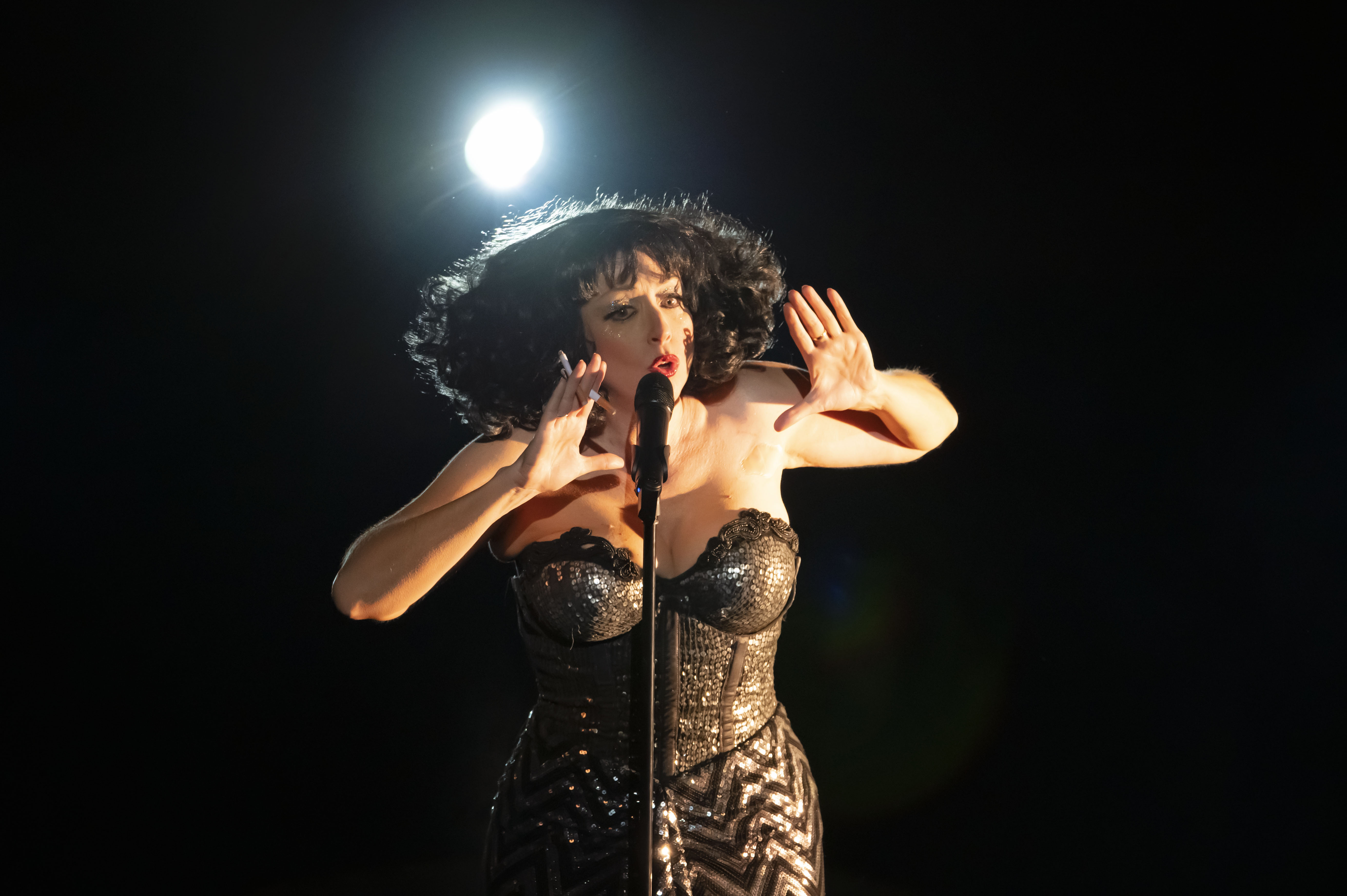
Meow Meow
In her Apocalypse Meow, the prima chanteuse Meow Meow describes herself as “a showgirl of gargantuan proportions”.
Never was a truer word spoken, but, as always with Mme Meow, it’s necessary to peel away her layers of intent; of course there’s the sheer presence of her, the big hair, the phenomenal décolletage, the lips, the eyes, the Rockette pins.
Then there’s her stance; hands on hips, all challenge and control – control, that is, until the lights, or the smoke machine don’t work, the flowers aren’t thrown, it all goes wrong – “I suppose I’ll have to do this myself” she snarls, a pussycat becoming a very pissed off tigress.
Its all an act –
no, it's The Act – and a brilliant, insurrectionary one, and she injects snatches of
it throughout her PICF show.
But for the most part she stripped the tomfoolery
away and concentrated on the songs, curated with her usual immaculate taste and
subversive purpose, from Laurie Anderson’s 'The Dream Before' (“history is an
angel being blown back into the future”) to her mate Amanda Palmer’s murderous
'Miss Me', from Patti Griffin’s tender, lovely 'Kite Song' to the Brecht/Weill
canonical 'Pirate Jenny' and 'Surabaya Johnny', but also Brecht and Hanns Eisler’s
hauntingly prescient 'Deutsches Miserere'.
There were also original songs written for her with Megan Washington (‘Skeleton Key’) and in collaboration with Pink Martini’s Thomas Lauderdale (‘I Lost Myself’) and Iain Grandage(‘Tear Down the Stars”’)
Alone but for the immaculate accompaniment of Mark Jones (piano) and Dan Witton (bass), Meow Meow went much of the way to granting me a wish I made in a review a decade ago: “There are times when she should trust the songs and her singing of them instead of interrupting herself with comedy. I’d love her to just sing to me.”
Gill Hicks
On the night of Meow Meow the foyers of the Maj were abuzz with praise of Gill Hicks’s Still Alive (and Kicking), so, with some gentle prodding from PICF’s indefatigable Ali Welburn, I was back on Saturday afternoon for her show.
Why had I not always planned to see it? Hicks was a victim of the July 2005 London bombings, and lost both her legs in the explosion on board the train she was traveling in. I must confess this tragic story didn’t sound like the makings of a fun hour of cabaret.
How wrong can you be!
Still Alive (and Kicking) is, instead, a quietly glorious story, completely free of self-pity or bitterness, beautifully told and shot through with humour.
The image of Hicks being rushed to hospital without any sign of life for 30 minutes other than that she is talking non-stop, or insisting on going to the hospital morgue to say goodbye to her legs, are drilled into my memory.
There are images and characters just as human and memorable: Adrian, the man she never knew who saved her life as he lost his by being between her and the bomb blast; Matt, “the geezer” who guided her through her prosthetic rehab (“I can’t stop you from falling, but I can help you get up”); waving her prosthetic leg out the taxi window as she finally left hospital.
And there are
songs, performed with a remarkable duo, Dylan Paul on double bass and Julian
Ferraretto on violin and, or all things, saw.
Among her many achievements, Hicks is a stylish and engaging jazz singer, and
the smooth arrangements of 'Stayin’ Alive' (accompanied by aforementioned saw), 'Summertime', 'Bye Bye Blackbird' and 'I’m Feeling Good' gave the standards a
musical freshness as well as an urgent dimension.
And, as she says, “being alive is a damn good thing to have whilst you have it.”
Closing Night Gala
There are obvious joys in festival galas, and hidden ones too.
If you come to them cold, you get a snapshot of the highlights of the programme you didn’t see.
So, if that’s you, you got lucky, with festival director Michael Griffith’s snappy opening ('Another Opening, Another Show'), the esteemed Noongar artists Gina Williams and Guy Ghouse ('Moon River' – in Noongar and sing-a-long English – and the willy-wagtail song 'Djidi Dgidi') and double-barrelled showstoppers from the festival's headliners Paul Capsis and Meow Meow.
But if, like me, you’d seen many of the shows in the festival, there were other delights:
Libby Hammer and Ali Bodycoat were all wit and breeze in their festival hit Over the Rainbow, but whack them on the big Maj stage with a full band and they had the crowd roaring to their Kylie Minogue mash up and a barnstorming take on the legendary Streisand/Garland medley, 'Get Happy/Happy Days are Here Again'.
I was critical of Brigitte Hauser’s Maria, Marlene and Me that got bogged down in a clunky narrative which, I thought, threw her performance off kilter, but, at the gala and back in her natural environment, and with Rossini’s 'Una Voe Poco Fas' to work on, she really shone, letting both her pipes and physical comedy chops rip. More of the same, Brigitte!
While Gill Hicks was an impressive interpreter of the standard numbers in her Still Alive (and Kicking) earlier in the day, her one-song stand at the gala, 'Stayin’ Alive' went to another height on the big stage. Even leaving aside her extrordinary story she’s a compelling, complete artist.
And that was that. The second Perth International Cabaret Festival took itself downstairs for a few more songs and quite a few more drinks, the ghost light was switched on and all the songs, and all the laughter and applause were just echoes to add to the grand old theatre.
PICF is a great addition to Perth’s popular arts (the good news is that it’s back next year, and extended from two to three weeks), and, given the tough environment it was born into, everyone involved deserves a standing ovation.


