Monday, February 21, 2022

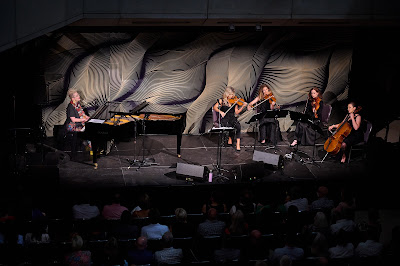
Music: Katie Noonan with strings

Katie Noonan
with the Sartory String Quartet
: Pascal Whiting and Susannah Williams (violins), Katherine Porter (viola) and Sophie Curtis (cello)
Art Gallery of Western Australia
February 18, 2022

(pic: Court McAllister)
Katie Noonan has crafted a remarkable career as a singer, musician, songwriter, artistic director and musical patron over more than two decades (although it’s fair to say her musical education began in the womb of her opera singer mother, Maggie).

While she has hardly snuck up on us, her musical interests and accomplishments since she emerged as a lead singer with her band George and their No 1 album Polyserena in 2002 are so wide-ranging as to be an amazement.

Much to the joy of the audience in the grand foyer of the Art Gallery of Western Australia, Noonan took us for an exhilarating ramble across many of the years and styles of that career.

It fell, essentially, into two parts; the first, Noonan at the piano and the Sartory string quartet performed lush, romantic ballads from across her repertoire; the sweet, simple Quiet Day, the gentle torrent of Bluebird, like wind over wings; her setting of Michael Leunig’s sotly-spoken Peace is My Drug, and Lover, My Song for You, her wedding present to her husband, the saxophonist Isaac Hurren (she says he took some time to reciprocate).

This is lovely music, made even more impressive by Noonan’s vocal restraint; there’s not an instant of her using her powers merely to impress – she gives the songs exactly what they need, with very little embellishment, allowing us to slip quietly into their beauty and emotion.

That restraint is also apparent in the arrangements by Dr Steve Newcomb from the Queensland Conservatorium at Griffith University, and is given vivid life by Pascal Whiting and Susannah Williams (violins), Katherine Porter viola) and Sophie Curtis (cello) of Sartory.

After a sad aside concerning the failing health of the great jazz pianist Keith Jarrett (and thanks, Kate, if you could leave the steak knives at the Festival office I’ll pick them up from there), the temperature of the show changed as Noonan left the piano for centre-stage and more complex vocal music featuring the words of two revered Queensland poets, Oodgeroo Noonuccal (Cath Walker) and Judith Wright.

Wright’s Late Spring has been set to music by the illustrious and prolific composer Elena Kats-Chernin, while the settings of Oodgeroo’s The Curlew Cried and Balance were from Queensland composers Thomas Green and Robert Davidson respectively.

The songs, often in minor keys, are musically challenging and unsettling, but Noonan’s taste and vocal tact are constant.

They are also –and this is clearly something of great pride for her – orchestrations she has commissioned, which is an admirable gift to Australian music.

The show ends on a high – Noonan’s own setting of Noonuccal’s anthemic A Song of Hope (“New rights will greet us/ new mateship meet us/ and joy complete us/ In our new dreamtime”) and the high romance of her breakout Breathe in Now.

It gave me an inkling of why she mentioned Keith Jarrett. As she pointed out, he’s famous for his cries of pleasure as he’s playing.

It’s an immersion in the music that has a physical expression she shares with him and other singers – Antony Hegarty and the incomparable Joe Cocker among them – who lose themselves in those same transports of delight.

It was a great joy for us to be taken there with her. 


Monday, February 14, 2022

Musical: Panawathi Girl

by David Milroy
Yirra Yaakin Theatre Company
for the Perth Festival
Director Eva Grace Mullaley
Musical Director Wayne Freer
Choreographer Janine Oxenham
Set designer Bruce McKinven
Lighting designer Lucy Birkenshaw
Sound designer Jeremy Turner
Performed by Grace Chow, Peter Docker, Luke Hewitt, Chris Isaacs, Geoff Kelso, Angelica Lockyer, Nadia Martich, Lila McGuire, Gus Noakes, Teresa Rose, Maitland Schnaars, Manuao TeAotonga and  Wimiya Woodley
His Majesty’s Theatre
February 10 – 13, 2022
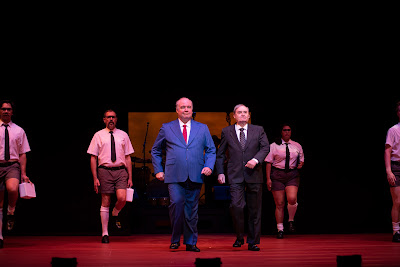
Luke Hewitt and Geoff Kelso and the Long White Socks  (pic Dana Weeks)

It’s easy to see why much excitement accompanied the world premiere of David Milroy’s Panawathi Girl, and it’s pleasing to report that it’s a catchy, warm-hearted show that understands the simple virtues of the Broadway musical while maintaining a distinctly Australian – and specifically West Australian – flavour.

It’s also a good example of the long process required to take a story idea and a collection of songs and moulding them into an integrated, exciting, finished product.

Panawathi Girl, which began its journey as Rodeo Moon, a hastily-produced season for WAAPA’s Aboriginal Theatre course in 2015, is well down that path. It has a little way to go yet, and this abbreviated Perth Festival season is a giant step in its evolution.

There’s much that is already ready to go; the band – musical director Wayne Freer Bass and tuba), the legendary Lucky Oceans (pedal steel guitar), Adam Gare (violin, mandolin) and Milroy himself (guitar) is exquisite, and Milroy’s songs, appropriately enough largely in classic country and western style, fit it like a glove.
There’s well-developed comedy too, highlighted by veterans Luke Hewitt and Geoff Kelso in a Laurel and Hardy-style double act as Gough Whitlam and John Gorton –the play is set in 1969 as Australia lumbers toward the “Don’s Party" federal election and grapples with the ramifications of the 1967 Aboriginal Citizenship referendum and the stirring of the land rights. Hewitt has Big Gough down pat (Gorton himself doesn’t provide quite the same comic potential, but Kelso could make reading the instructions for downloading the ServicesWA app side-splitting); their big number “Long White Socks” is a hoot.

Just as hooty are the rag-tag trio of hippies (Grace Chow, Manuao TeAotonga and Chris Isaacs) who also arrive in Chubb Springs, the home town of their friend Molly Chubb (Lila McGuire), who has taken a break from her uni politics studies in Perth to find the grave of the mother she never knew. Isaacs, curly haired, harmonica-braced and folk-guitared like a gormless version of Bob Dylan, is a barrel of laughs, and TeAotonga’s drag act in the Rodeo Queen talent quest is an outrageous highlight.

As he showed in his 2011 Perth Festival smash Waltzing the Wilarra, while Milroy doesn’t sugar-coat the important and confronting messages he’s conveying, he uses the conventions of the musical to insinuate them into the narrative. While in many ways, the plot and characters of Panawathi Girl mirror those of the Gershwins’ frothy Crazy For You (which, coincidentally, was revived at The Maj last June by WAAPA’s Music Theatre students), the evils of bigotry and segregation in Chubb Springs are endemic, and unapologetic.
That story is played out by Molly’s conflicted white father (Peter Docker), the grifting rodeo king Buckley (Maitland Schnaars) and the young people of the town and rodeo troupe.

Docker and Schnaars are in familiar territory here, and the two fine, experienced actors give their characters depth and authenticity.

Some cast members are not always as comfortable with the particular demands of the musical – to be fair it was an opening night without the benefit of a run of previews – and it led to occasional awkwardness and hesitancy in the performances.

Not so for Gus Noakes as Knuckles, the rodeo cowboy, who’s rollicking baritone vocal on Rodeo Moon and confident hoofing are a delight.

There are plenty of moments to shine, though, for the young, talented McGuire, Teresa Rose as Knuckle’s sweetheart and co-worker Ada, Wimiya Woodley as Molly’s protective brother Billy, Nadia Martich, who combines ensemble work with the dance captain’s duties, and Angelica Lockyer (who role is hidden behind a spoiler alert curtain).

This is a signature production for Yirra Yaakin, confirming their status as both Australia’s leading Indigenous theatre company and one of the pillars of West Australian theatre. The director (and Yirra Yaakin artistic director) Eva Grace Mulalley has taken the company to the most prestigious of our main stages with an elite team of creatives, including the choreographer Janine Oxenham, set designer Bruce McKinven, costume designer Lynn Ferguson, lighting designer Lucy Birkinshaw and sound designer Jeremy Turner, and a stage management and dressing crew led by Jenny Poh.

It’s an impressive mark of confidence in the company’s capacity, and on David Milroy’s rare talent to tell stories that need to be told with terrific tunes, humour and purpose.

I only wish this Perth Festival season were longer to give the cast more time to completely find their feet, but I’m sure this won’t be the only time we see Panawathi Girl, so their time will come.

And like all good things, it will be worth the wait.   


Wednesday, February 2, 2022

Theatre/Dance: Salome δ

Squid Vicious
Devised and performed by
Olivia Hendry and Andrew Sutherland
Directed by Joe Lui (with creative producer Briannah Davis)
Designed by Declan Macphail
Sound and light design by Joe Lui

I’ve seen two versions of, or at least in a trajectory around, Oscar Wilde’s Salome. The first (showing my age again) was Lindsay Kemp’s hallucinogenic, slow-motion marvel at the London Roundhouse in 1977 that made it, and him, icons of their age.
The second, far more prolix and topical than Kemp’s, is a Summer Nights production at the Blue Room. (Those of you who’ve been feeling there’s something missing from this year’s Fringe World, that’s what it is.)

The dancer Olivia Hendry and the polyalternatist Andrew Sutherland have wrapped themselves in Joe Lui’s dense son et lumiere, Declan Macphail’s Siamese twin-set of an Aubrey Beardsley gown, and Lui and Briannah Davis’s minutely reactive direction. Then, layer by layer of exquisite, excruciating pain, they dance their seven veils for us.
There’s a consumptive nostalgia for illness embroidered into those veils, transformed into an aesthetic beauty, like Rosetti’s Beata Beatrix.

And they are beautiful; Hendry, pale, with breasts exposed like Beardsley’s Salome, Sutherland reptilian, microphone and stand raised aloft like photographs of a Jim Morrison.

Sutherland is declamatory, much in the way of Allen Ginsberg, and he takes us on a nightmare journey through the underworlds of the diseases of our time, HIV/AIDS, anorexia and, now, COVID; Hendry is silent, orbiting, covering and uncovering in the material that binds them both, unravelling away and spinning back to him.
It’s an intensely personal double-act, the dancer and the poet, drawn from experience, repetitive and insistent.
Finally, quite unexpectedly, when all the veils have been removed, Sutherland becoming a dancer, Hendry an orator, in a pas de deux of joys and sorrows.
It reminds you – this is a show that incubates memory – of Leonard Cohen’s “And when we fell together/ All our flesh was like a veil”.
There are no veils of secrecy in this Salome, though it is complex, both in its messages and its tempo, and might be impenetrable if you hit its atmosphere at the wrong angle.

But, like a dance, or a poem, or a deathbed, it has an honesty that can only arise in places where there’s nothing else left to lose.

(You'll enjoy Nina Levy's insightful review in Seesaw Magazine here)

Salome δ is at the Blue Room until Feb 5.


Wednesday, January 19, 2022

FRINGE WORLD 2022

“There may be trouble ahead
But while there's music and moonlight
And love and romance
Let's face the music and dance*”

*only at weddings

Tomás Ford and his happy uke

Here comes another year with the grim prospect of empty promises and empty shelves, of damn statistics, unobtainable tests and angry tweets lour’ding upon our houses.But, my friends, while there’s Fringe World, there’s hope.
So, for the twelfth year, Turnstiles slips on its mask and takes to the spiegeltents and converted classrooms, its thimblefuls of sponsored wine in plastic cups, to tell you about the music and dances. 
Here goes…

Laura Davis: If This Is It ★★★★
Laura Davis has made it pretty good since she left Perth (more specifically Kelmscott) for the bright lights of Melbourne and London as a mere slip of a comedian back in the ‘Naughties. There are fringe and comedy festival awards aplenty, and a stint as a writer for two seasons of Shaun Micallef’s Mad as Hell on her cv.

Davis is back in her home town after a couple of years stranded in New Zealand (that could almost be a slogan for the NZ Tourism Board) on COVID-related business, and her If This Is It is a progress report on her life and career, and her prognostications on the future of both.

Stripped of the jokes – which are frequent and seriously funny – she paints a grim picture of the life of a jobbing comedian, and a human being, in the here and now.

Inevitably her concerns are dominated by COVID and the state and future of the environment; not surprisingly she’s able to wring more humour out of the former, though she’s funniest when she’s able to divert from either.

I’m a bit constrained here – telling a comedian’s jokes in a review is the lowest form of spoiler, and merely saying “the jokes are very funny” is a bit like saying “vaccines can kill you” without being able to give examples.

So, like anti-vaxxers’ blather, you’re just going to have to take my word for it.

I can safely tell you without giving her game away that Davis can teach you how not to get murdered in Kelmscott (easy if you know how), how arguing with a climate denier is like getting into an oven with a fruitcake and how weird leather toy cows are.

The rest I recommend you hear from her direct.

A final note: Davis ends with her fears about bearing and raising a child in this world. It’s sweet, and then quirky, enough – she would raise and love the child for a couple of year and then leave it on the doorstep of a fundamentalist church. Her reasoning, and the apocalyptic image it leads to, are likely to stay with you long after the show finishes.

And they aren’t funny at all.
(I really like Erin Hutchinson's take on the show in Seesaw Magazine here)

ALLSTARS ★★★★

Hannah Davidson, Rebecca Fingher and Sian Murphy graduated together in WAAPA’s Performance Making class of 2019. The inventiveness, energy and self-reliance that that admirable cross-disciplinary course brings out are everywhere in ALLSTARS.

It starts with a flashy live and multimedia opening number that is tons of fun as well as setting up the characters and how they’re going to go about their mission – which, they tell us, is “becoming famous, filthy rich, and ready to sell our souls to do it”.
Being logical gals, they start by working out where they want to get to. They reckon success is sealed by being the most famous person in the world, and after some googling they decide that is Dwayne Johnson. You get the idea?

The show is co-created and directed by prima fringerina Charlotte Otten, has terrific pace and savvy, and is much enhanced by some superbly constructed and often hilarious multimedia work from Murphy and Otten, sound designer Bec Price and lighting designer Katrina Johnston.  And Davidson, Fingher and Murphy all have more chops than an Australia Day barbecue in Hall’s Head.

(Read my complete review in Seesaw Magazine here)

Tomás Ford’s Ukulele Torture Camp ★★★½

Tomás Ford’s Ukulele Torture Camp continues the same demented exploration of the psyche of the eponymous characters he has created over the years.

This year’s “Tomás Ford” is, of all things, a scoutmaster leading a Jamboree (though how he got a Working With Children card is the stuff of the front page headlines in The West Australian these days).

At tonight’s concert he’s entertaining his young charges on the ukulele with a selection of his own tunes. Some of the titles alone – Daddy Issues, ABBA Sex Dream, Hallucinations of You, and Naked in a Stagnant Pool are among the milder – should disabuse you of any thought of taking the kiddies to see it.

It’s a mess, but by the time he’s finished with us, we’re forgiving his failures, cheering his successes – and getting what he’s on about.

(Read my complete review in Seesaw Magazine here)
Bogan Shakespeare: Julius Caesar
★★★★

If ever a play needed to be re-set at a Bunnings store in Busselton and given the Bogan Shakespeare treatment, Julius Caesar is it.

The Bogan Shakespeare gang has achieved a rare feat (the comedian Dr Ahmed might be the only other example). With tenacity, good marketing and a keen sense of what works for an audience out for a good time and some laughs, they’ve built themselves into a perennial Fringe World powerhouse.

That’s not to dismiss the quality of the work. Their scripts are tight and acute, their performances full of life and appealing self-awareness, their cultural literacy – whether it’s Shakespeare or corporate chicanery – is spot on and the whole package is really, really funny.

(Read my complete review in Seesaw Magazine here)

Bang Town ★★½
Improv theatre is lots of fun to watch but it’s a bugger to review, simply because every performance is a one-off, and its success or failure depends on things the performers have minimal control over.

It means a reviewer’s role as a consumer advocate is impossible to deliver on, because what they send you scurrying off to see won’t be what they reported on.

So if I tell you that last night’s Bang Town! was tedious, repetitive and meandered off course, that doesn’t for one second mean the show you decide not to go to tonight won’t be hilarious, inventive and have you in real danger of collapsing in fits of uncontrollable laughter.
(Read my complete review in Seesaw Magazine here)

The Odyssey ★★★½
The high-octane little troupe of Thomas Dimmick, Hock Edwards, Grace Edwards and Erin Craddock have an appealing grasp of pantomime and a suitably disrespectful feel for Homer’s great yarns.

They had a surprise hit at last year’s fringe with Troy Story so it was only natural that they should have a crack at it’s sequel this year.
I’d like to say the story of the Odyssey is so familiar to modern audiences that it hardly needs retelling here, but sadly I suspect that’s not the case.
It’s far too complicated and episodic to even attempt to précis here, so let’s just say it’s the one with the Cyclops and the Sirens, the nymph Calypso (Grace Edwards) and the witch Circe (Dimmick), Poseidon and his typhoons, Zeus (Craddick) and his thunderbolts. There are useful sheep magic, and forbidden but delicious-looking cattle.
Nearly everyone who isn’t immortal dies and some of them get eaten – no wonder it’s been popular for coming on 3,000 years.

(Read the complete review in Seesaw Magazine here)

Kind Regards, Michelle Aitken ★★★
The deviser and performer Michelle Aitken has been in and around some of the most interesting work in the Perth indiverse for the past five or so years, and the result of her experience is disciplined, confident, hard edged and yet somehow lovable.

So Kind Regards, Michelle Aitken, her loosely-described autobiographical performance piece comes as little surprise, but its jaunty mix of self-indulgence and self-deprecation shows what an adept tightrope-walker she’s become.
Her subjects – the gig economy, the side hustle, the indifference of the secure and the frustration of the insecure, dads – all get a thorough workover, but it’s the how rather than the what of her observations that set Kind Regards apart.
Aitken is, among other things, a dancer, and I’m the first to admit that art form has a language I don’t speak – I call it “Drench”, because I have no French either ­– but her physical performance is so contextual and clear even I can understand it (she’s even given me my first Drench word, a horizontal side-swipe that means “delete”).
Add to that some wry observations and some tightly controlled mood shifts as she exhumes the skeletons behind what seem day-to-daily events and you’ve got a well-worthy adventure in the underworld in which so many people now live.
(These are just some random observations; my colleague at Seesaw, Nina Levy, tells the whole story here.

Coming soon to Turnstiles:

Aire Spanish Flamenco

Barrelhouse Trio

Salome

Saturday, November 20, 2021

Theatre: Dating Black

 by Narelle Thorne

Yirra Yaakin Theatre Company

Directed by Bruce Denny

Choreographer Nadia Martich

Set and Costume designer Matthew Raven

Lighting designer Peter Young

Sound designer Ella Portwine

Dramaturg Polly Low

Subiaco Arts Centre November 18 - 27, 2021 

Bobbi Henry, Tegan Mulvany and Derek Nannup

Love is all around in Yirra Yaakin’s brand spanking new humdinger of a rom-com – and as always with love, things are never black and white.

Dating Black, the debut play by Narelle Thorne, is a laugh-a-minute romp through the minefield of dating and romance, but it’s a lot more than that.

It achieves a remarkable double – it’s as light as air, the story of five really nice people who all get what they want and need without serious conflict or major setbacks, but I think you can make a case that it’s also one of the more significant new plays on the Perth stage in recent times. I’ll get back to that.

The five nice people are BFFs Djinda (Bobbi Henry) and Hope (Tegan Mulvany), Djinda’s brother, Marley (Maitland Schnaars) her auntie Maisie (Rayma Morrison) and a new bloke in town, Justin (Derek Nannup).

Djinda’s moved back in with family after her marriage ended badly, and like Hope, who is also single, is absolutely available. Her aunt Maisie is no obstacle to their romantic ambitions, but the same can’t be said of Marley, whose protective nature is suffocating.

The girls are out on the town (they’ve told Maisie they’re going to “church” but they mean the local nightclub of that name, not a building with a pulpit in it), and run into Justin, who’s visiting on business.

Djinda and Justin get on like a house doused in petrol and set alight, which is fine by Hope and Maisy – not so much with Justin though. Ah, but the course of true love…

Thorne writes with sweet insight and a fetching, light feel for comedy, and she and first-time director Bruce Denny make Dating Back’s 75 minutes a rib-tickling pleasure.

And it’s brought to life by a fabulous bit of casting; Bobbi Henry is a knockout as Djinda, mercurial and sexy as all get-out, and Tegan Mulvany matches her fire and sparkle; Derek Nannup is a perfect foil for Henry, debonair and sincere, he does the dark horse to a T.

Let’s give it up for Rayma Morrison; a born comedian, she’s as wise as she is wisecracking, impish, the funny bone of the show – we should all have an auntie like her.

And a brother like Maitland Schnaars; this excellent, statuesque actor is clearly enjoying working a comedy, and his dignity shines through even when he’s the butt of many of Dating Black’s jokes. (By the way, Schnaar’s daughter Cezera is starring in the brilliant Little Women at the Blue Room – check out your diary, you’ve only got a week to catch them both!)

So why is Dating Black so important? It’s the most natural yet development of a significant change in Aboriginal, and especially Noongar, theatre so powerfully led by Yirra Yaakin under its artistic directors Kyle Morrison and now Eva Grace Mullaley.

In it, Indigenous people, their lives, their familial and community cultures, are not represented as needing explanation let alone justification.

In Dating Black there is no signposting or drum-beating at all (and I’m not here suggesting that they haven’t been legitimate, or necessary, given the history of colonialism, neglect and oppression in this country). The people of this play are leading lives on their own terms, and our common humanity goes without saying.

Just as important, and a source of great inspiration, is the continued rise of Noongar language. Yirra Yaakin, with their all-Noongar Hecate and Fists of Fury in the last two Perth Festivals, are leading this process, as are performers like Gina Williams and Guy Ghouse, with their lullabies, songs, and now even an operetta, in language.

The increasingly complex and insightful Welcomes to Country are another platform for knowledge and appreciation of the language.    

Dating Black is in English, sprinkled with Noongar words and phrases that are becoming better known and added to our general vocabulary.

This is a wonderful thing, because Noongar is a beautiful and expressive language. Its return as a widely-known and naturally adopted living language, the de facto second language of West Australians if you will, is something we should all hope for and look forward to.


Tuesday, November 2, 2021

Theatre: Queer as Flux

Written and performed by Stace Callaghan

Directed by Leah Mercer
Lighting designer Peter Young

Sound Designer Olivia Cosham

Blue Room Theatre October 26 -  November 13, 2021

There’s nowhere else to begin but with admiration – for the powerful and courageous life Stace Callaghan has lived and continues to live, for their emotional insight and poetic command of language, and the sheer energy and honesty of their performance.

Callaghan has taken the world head on – not because they have an axe to grind, a sermon to deliver or a point to prove, but because they are prepared to reach out for freedom, and to wear the scars that come with it.

Growing up in that big old dirty river town Brisbane in the 1980s was tough enough for any kid (I did it a couple of decades before then and it was no joke); behind the glitz of Expo on the South Bank and the maroon ecstasies of Lang Park and King Wally Lewis, there were the shadows of Bjelke-Petersen and Hinze, the white shoe brigade and Commissioner Terry Lewis.

For the queer community it was a hostile, even dangerous, place to be.

But Callaghan survived it, in some inward sense thrived in it, and the person who emerges so clearly as they tell their story, is an inspiration, not just to LGBTIQ+ people but to anyone who seeks freedom and change where it is not encouraged or even available.

Of course there are scars (and those who might struggle with physical ones should be warned – though not discouraged), and Callaghan is remarkably frank about those they has suffered and, by and large, overcome.

Such is their felicity with language, though, and such is their sweet soul, that the journeys they take us on have touching pleasure and sharp humour of their own.

So that transition, in the universal as well as the personal, is their purpose and subject (they delight in Transperth by the way), whether it’s the story of how their mum and dad have changed, or the last moments of their beloved dog.

And Queer as Flux has spirituality, anchored in Callaghan’s real life but aloft on their imagination; so a recurring encounter with whales on Hervey Bay in Central Queensland becomes a phantasmagorical meditation on ecology and change.

Leah Mercer, whose work with her The Nest Ensemble co-founder Margie Brown Ash has produced some of the most memorable Blue Room performances of the last decade, directs with astuteness and touch, and the interplay between light and sound (Peter Young and Olivia Cosham) is nanometre-perfect.

Unfortunately, somewhere in the process of organising Queer as Flux’s content, an awkward, superfluous character, the drag queen Polly Tickle, is injected into the narrative (though not Callaghan’s life, where Polly plays no discernible part).

Polly’s main purpose seems to be to provide a LGBTIQ+ historical context into Callaghan’s own story, but much of it is common knowledge and that which isn’t could have been left to Stace themselves to tell – much more effectively.

That aside, this is a powerful performance and an insight into lives lived differently, and bravely, that will reward your attention.      


Sunday, October 10, 2021

Theatre: Animal Farm

by Van Badham

from the novel by George Orwell

Black Swan State Theatre Company

Directed by Emily McLean

Set and Costume designer Fiona Bruce

Composer and sound designer Rachael Dease

Lighting designer Karen Cook

Video designer Michael Carmody

Performed by Andrea Gibbs, Alison van Reeken and Megan Wilding

Heath Ledger Theatre until October 24, 2021

Alison van Reeken, Andrea Gibbs and Megan Wilding (pic Daniel J Grant)
In 1992 the political scientist Francis Fukayama claimed the final victory of Western liberal democracy over its various competitors and, on that basis, declared The End of History in his hugely influential book with that title.

Just goes to show how wrong you can be.

The fall of the Berlin Wall, the end of the Cold War, the collapse of the Soviet empire and its satellites that Fukayama saw as the dawn of some kind of political stasis might also have consigned George Orwell’s Animal Farm – the savage parable of the Stalinism he felt had betrayed democratic socialism and attacked objective truth – to the remainder bin of admirable curiosities like its near-contemporary, Charlie Chaplin’s The Great Dictator .

Van Badham’s stage adaptation of Animal Farm is a brave attempt to release Orwell’s parable from the specifics of the mid-twentieth century USSR and put contemporary flesh on its bones.

It’s successful in very large measure because of scorching performances from three tremendous actors, Andrea Gibbs, Alison van Reeken and Megan Wilding, who play its 17 “live” characters and a host of others on film and audio.

They are carefully placed front and centre, facing straight out to the audience, by the director Emily McLean, who shows the respect and felicity for clear, cleanly delivered dialogue and simplicity of action that makes her work so constantly accessible and satisfying.

Which is not to say this Animal Farm is merely neat or tidy. Gibbs, van Reeken and Wilding keep things gloriously salty, and video designer Michael Carmody and composer/sound designer Rachael Dease rub it into the wounds with intent.

The result is seriously funny as well as deadly serious, as brightly energetic as previous attempts, notably the CIA-funded 1954 film version, have been grim plodders.

Animal Farm happens as much on a gigantic screen as on stage, and Carmody’s effects are terrific; he films the cast in their stage characters and many more beside (a total, at a rough count, of 37) interspersed with mocked up media reports, mainstream and on-line media and revolutionary graphics.

It’s a whirligig of imagery and, combined with the three marvellous performances, an exciting experience.

But does it hit its mark, both as an adaptation of Orwell’s original and as an invention of its own?

The answer to the first question is a resounding yes.  The Orwellian nightmare is fiercely imagined, his outrage and despair clearly displayed. The process of totalitarianism, its betrayal of noble heroism and the common good, and the re-writing of history it requires, is brutally exposed.

The story of Napoleon and Squealer, Mollie and Snowball, Benjamin, Mr Jones and the tragic Boxer – so familiar they need not be repeated here – are retold with fidelity to the original.

I think, though, an opportunity – or at least an accuracy – has been missed in this updated Animal Farm, although it’s hard to level blame on this production or Badham.  This piece was conceived in 2019 and was intended to be performed just before the 2020 US Elections. It’s been updated right up to the paroxysm of January 2021 in the US Capitol Building.

It’s obvious enough, given the times, that Trump/Napoleon should be the successor to Stalin/Napoleon, but he really isn’t. Trump has been a spectacular failure as a would-be dictator, destroyer of the truth and politician. He’s no Napoleon.

A far better example of the type that caused Orwell so much grief and anger is on 24/7 news cycle display much closer to home.

Instead of “Make Animal Farm Great” as the ubiquitous slogan for this rambunctious, bitterly funny tour de force of a production, I’d suggest “How Good are Animals” would have been closer to the mark, and to the bone.